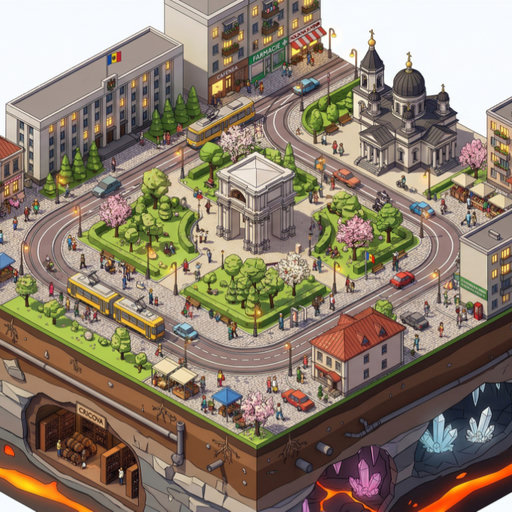
Build detailed isometric miniature worlds with cross-section views, tiny characters, and rich environmental storytelling. Great for game art, social media, and illustration.
An intricate isometric diorama of [SCENE DESCRIPTION], viewed from a perfect 30-degree isometric angle, every element rendered with pixel-perfect precision, the scene contained within a floating cube-shaped island with visible cross-section showing underground layers (soil, rock, magma, crystal caves), miniature figures going about daily life with visible activities and interactions, warm interior lighting glowing through tiny windows contrasting with cool ambient exterior light, seasonal atmosphere of [SEASON] with appropriate weather effects, a winding path connecting all key areas of the scene, hand-crafted details like shop signs, potted plants, and laundry lines, color palette: [PALETTE DESCRIPTION], rendered in a style between low-poly 3D and detailed illustration, clean edges with subtle ambient occlusion shadows, white background for easy compositing
Create stunning Art Deco travel posters in the classic 1930s WPA style. Perfect for wall art, branding, and retro design projects.
A vintage travel poster for [DESTINATION] in the style of 1930s Art Deco WPA posters, bold geometric shapes and simplified forms, limited color palette of [3-4 COLORS] with strong contrast, hand-lettered typography reading [HEADLINE TEXT] in an elegant serif typeface at the top, iconic landmark or landscape of the destination rendered as flat graphic shapes with subtle gradients, decorative border with geometric motifs, slight paper texture with aged patina and gentle fold marks for authenticity, composition uses strong vertical lines and symmetrical balance, warm nostalgic atmosphere, print-ready at 18x24 inches, inspired by the golden age of travel poster design by artists like A.M. Cassandre and Roger Broders
Generate professional character design turnaround sheets for animation, games, or illustration. Includes multiple angles, expression studies, and color palettes.
Professional character design reference sheet for [CHARACTER NAME], a [CHARACTER DESCRIPTION], showing front view, three-quarter view, side profile, and back view arranged in a clean 2x2 grid on a neutral gray background, consistent proportions and lighting across all views, detailed facial expression studies in smaller insets showing happy, angry, sad, and determined emotions, color palette swatch strip along the bottom edge with hex codes, height comparison silhouette next to a standard human figure, key costume and accessory callouts with thin leader lines, art style: [STYLE such as anime, Western animation, realistic, stylized], clean linework with flat color fills, suitable for animation production pipeline, white border separation between views
Generate otherworldly surreal landscapes that blend impossible physics with organic beauty. Perfect for album covers, concept art, and creative wallpapers.
A surreal dreamscape where [MAIN ELEMENT] floats weightlessly above an infinite [LANDSCAPE], gravity-defying architecture with impossible M.C. Escher-inspired geometry, bioluminescent flora growing from crystalline structures, sky transitions from deep indigo to molten copper with twin celestial bodies casting contradictory shadows, liquid mercury rivers reflecting a world that does not exist above them, tiny human figures providing scale against the cosmic backdrop, texture contrast between organic growth and geometric precision, atmosphere thick with luminous particles like captured starlight, rendered in the style of [ARTIST REFERENCE], aspect ratio 16:9, ultra-detailed with tack-sharp focus throughout
Create cinematic movie-quality stills with professional cinematography techniques. Fill in the bracketed placeholders for your scene. Works best with dramatic lighting and atmospheric settings.
A breathtaking cinematic still of [SUBJECT] in [SETTING], dramatic volumetric lighting with golden hour rays piercing through atmospheric haze, deep depth of field with foreground bokeh elements, color palette inspired by [FILM REFERENCE], anamorphic lens flare catching the light source at 45 degrees, 2.39:1 ultra-widescreen aspect ratio, film grain overlay matching Kodak Vision3 500T stock, shadow detail preserved in crushed blacks, practical lighting motivation from visible sources within the scene, emotional tone: [MOOD], camera positioned at [ANGLE] with subtle dutch tilt for dynamic tension
Hyper-realistic portraits with natural lighting and medium format film aesthetic
[trigger:flux] Photorealistic close-up portrait of [SUBJECT DESCRIPTION], shot with natural window light creating soft Rembrandt lighting pattern, catchlight visible in eyes, shallow depth of field at f/1.8 with creamy bokeh background, skin texture and pores visible at pixel level without being unflattering, subtle color grading with lifted shadows and warm midtones, subject looking slightly off-camera creating an editorial feel, hair detail with individual strands visible, clothing texture clearly rendered, professional fashion photography quality, medium format film look with gentle grain
Comprehensive research reports with historical context, technical analysis, and future outlook
Using your extensive knowledge and ability to process large contexts, conduct a comprehensive research analysis on [TOPIC].

## Executive Summary (200 words)
The state of the field in plain language.

## Historical Context
Timeline of key developments with dates.

## Current State of the Art
- Leading approaches/technologies
- Key players and their contributions
- Recent breakthroughs (last 12 months)

## Technical Deep Dive
- How the core technology works (explain like I'm a smart engineer in a different field)
- Key trade-offs and design decisions
- Open problems and challenges

## Market & Industry Impact
- Market size and growth trajectory
- Industries being disrupted
- Adoption barriers

## Future Outlook
- 1-year predictions (high confidence)
- 3-year predictions (moderate confidence)
- 10-year speculation (informed guessing)

## Key Resources
- 5 must-read papers/articles
- 3 people to follow
- 2 communities to join

Cite specific sources where possible. Clearly distinguish facts from opinions.
STRIDE threat modeling with risk matrix and actionable security recommendations
Perform a threat modeling exercise for the following system using the STRIDE framework.

## System Overview
- Create a data flow diagram (ASCII) showing trust boundaries
- Identify all entry points and assets

## STRIDE Analysis

### Spoofing
- Threats identified
- Current mitigations
- Gaps and recommendations

### Tampering
[Same structure]

### Repudiation
[Same structure]

### Information Disclosure
[Same structure]

### Denial of Service
[Same structure]

### Elevation of Privilege
[Same structure]

## Risk Matrix
| Threat | Likelihood | Impact | Risk Score | Priority |
|--------|-----------|--------|------------|----------|

## Top 5 Recommendations
Ranked by risk reduction per implementation effort.

## Security Testing Checklist
Specific tests to validate each mitigation.
Lifestyle product mockups for marketing websites and social media
A professional product mockup showing [PRODUCT DESCRIPTION] in a lifestyle setting. The product is placed on a [SURFACE] in a [ENVIRONMENT] with soft natural lighting from a large window on the left side. Shallow depth of field with the product in sharp focus and a tastefully blurred background showing [CONTEXT ELEMENTS]. The scene conveys [MOOD/FEELING]. Color palette is [COLORS]. The composition follows the rule of thirds with the product positioned at the left intersection point. Photorealistic quality suitable for a marketing website hero image.
ML model selection with hyperparameters, evaluation strategy, and production considerations
You are a senior ML engineer. Given the following problem description and dataset characteristics, recommend the best approach:

## Problem Analysis
- Classification vs Regression vs Clustering vs Other
- Supervised vs Unsupervised vs Semi-supervised
- Online vs Batch learning

## Recommended Models (ranked)

### Model 1: [Best Choice]
- Why it fits this problem
- Expected performance range
- Hyperparameter starting points
- Training time estimate
- Inference latency

### Model 2: [Strong Alternative]
[Same structure]

### Model 3: [Simple Baseline]
[Same structure]

## Feature Engineering Suggestions
- Transformations to try
- Feature interactions worth exploring
- Dimensionality reduction if needed

## Evaluation Strategy
- Metric selection (and why)
- Cross-validation approach
- Train/val/test split strategy
- Baseline to beat

## Production Considerations
- Model size and serving requirements
- Monitoring for drift
- Retraining schedule

Provide sklearn/PyTorch starter code.
Refactor React components for performance, accessibility, and maintainability
You are a React performance expert. Refactor the following React component for:

1. **Performance**
   - Identify unnecessary re-renders
   - Add React.memo where beneficial
   - Use useMemo/useCallback correctly (not everywhere)
   - Split into smaller components at render boundaries
   - Lazy load heavy children

2. **Maintainability**
   - Extract custom hooks for logic reuse
   - Separate concerns (data fetching, state, presentation)
   - Use compound component pattern if applicable
   - Proper TypeScript types

3. **Accessibility**
   - Semantic HTML elements
   - ARIA attributes where needed
   - Keyboard navigation
   - Focus management

4. **Testing**
   - Component is testable in isolation
   - Side effects are injectable/mockable

Show before/after with explanations for each change.
Comprehensive competitive analysis with positioning maps and strategic recommendations
Conduct a thorough competitive analysis for [MY PRODUCT] against [COMPETITORS].

## Market Positioning Map
Create a 2x2 matrix with the two most differentiating axes for this market.

## Feature Comparison Matrix
| Feature | Us | Competitor A | Competitor B | Competitor C |
|---------|-----|-------------|-------------|-------------|

Rate each: (full), (partial), (none)

## Pricing Analysis
- Price points and tiers
- Value per dollar comparison
- Free tier comparison

## Strengths & Weaknesses
For each competitor:
- 3 strengths (what they do well)
- 3 weaknesses (where they fall short)
- Their likely next move

## Our Strategic Advantages
- Where we win today
- Where we need to catch up
- Blue ocean opportunities (unserved needs)

## Recommended Strategy
- Short-term (0-3 months): Quick wins
- Medium-term (3-12 months): Differentiation plays
- Long-term (12+ months): Moat building

Base analysis on publicly available information. Flag assumptions clearly.
Classic 80s synthwave album covers with neon grids, chrome, and sunset aesthetics
Retro 1980s synthwave album cover art, chrome text title floating in space reading [ALBUM NAME], neon grid plane extending to the horizon in hot pink and cyan, chrome DeLorean or sports car driving toward a setting sun, the sun is a gradient from yellow at top to magenta at bottom with horizontal scan lines, palm tree silhouettes flanking the road, starfield sky with subtle nebula clouds in purple and blue, chrome and neon reflections on all surfaces, scanline CRT monitor overlay effect, overall aesthetic inspired by Kavinsky and The Midnight album art, vibrant saturated colors, retro-futuristic --ar 1:1 --v 6.1
Production-grade Python data pipelines with quality checks and monitoring
You are a data engineer. Design a robust data pipeline for the described use case.

Provide:

## Pipeline Architecture
- ASCII diagram of the data flow
- Source → Transform → Load stages clearly labeled

## Implementation (Python)
```python
# Complete, runnable pipeline code using:
# - pandas for transformations
# - SQLAlchemy for database connections
# - Proper error handling with retries
# - Logging at each stage
# - Idempotent operations (safe to re-run)
```

## Data Quality Checks
- Schema validation (expected columns, types)
- Null checks on required fields
- Range validation for numeric fields
- Uniqueness constraints
- Row count reconciliation (source vs destination)

## Monitoring
- Metrics to track (rows processed, duration, error rate)
- Alert conditions
- Dead letter queue for failed records

## Scheduling
- Recommended frequency
- Backfill strategy
- Dependency management
Photorealistic architectural interior visualizations for design presentations
Photorealistic interior architectural visualization of a [ROOM TYPE] in [STYLE] style, professional architectural photography with tilt-shift lens correction, natural daylight flooding through floor-to-ceiling windows, carefully curated furniture placement following the rule of thirds, material textures rendered in hyperdetail (wood grain, marble veining, fabric weave), indoor plants adding organic warmth, subtle color story with [PRIMARY COLOR] as accent against neutral base, shot from eye-level standing position at room entry point, depth of field keeping the entire room sharp, ceiling detail visible showing architectural features, warm color temperature (5500K), inspired by ArchDaily and Dezeen photography --ar 16:9 --v 6.1 --style raw
Generate 20 email subject line variations for A/B testing. I'll give you the email purpose and audience.

Create variations using these proven frameworks:

**Category 1 — Curiosity Gap (5 lines)**
Create information gaps that compel opens.

**Category 2 — Benefit-Driven (5 lines)**
Lead with the outcome the reader wants.

**Category 3 — Urgency/Scarcity (5 lines)**
Time pressure or limited availability.

**Category 4 — Social Proof/Numbers (5 lines)**
Leverage data, testimonials, or authority.

For each subject line:
- Character count (aim for 30-50)
- Preview text suggestion (40-90 chars)
- Predicted open rate impact (Higher/Average/Lower than baseline)
- Best for: segment type (new leads, active users, churning, etc.)

Rank the top 5 recommendations for the first test.
Step-by-step system design interview walkthrough with diagrams and trade-off analysis
You are a principal engineer conducting a system design interview. Walk me through designing [SYSTEM] step by step.

## Step 1: Requirements Clarification (2 min)
- Functional requirements (what the system does)
- Non-functional requirements (scale, latency, availability)
- Back-of-envelope calculations (QPS, storage, bandwidth)

## Step 2: High-Level Design (5 min)
- ASCII diagram of major components
- API design for core operations
- Data flow description

## Step 3: Deep Dive (15 min)
- Database schema design with index strategy
- Caching layer (what to cache, eviction policy, invalidation)
- Message queues for async operations
- CDN for static content

## Step 4: Scale & Reliability (5 min)
- Horizontal scaling strategy
- Database sharding approach
- Failure scenarios and handling
- Monitoring and alerting

## Step 5: Trade-offs Discussion
- CAP theorem implications
- Consistency vs availability choices made
- Cost optimization opportunities

Use real numbers. Cite industry examples. Draw ASCII diagrams.
Structured customer interview script for product discovery with follow-up guidance
Generate a structured customer interview script for [PRODUCT/FEATURE] discovery.

## Pre-Interview (2 min)
- Rapport building questions
- Permission to record
- Set expectations for length and format

## Context Setting (5 min)
1. Tell me about your role and what a typical day looks like.
2. What tools do you currently use for [DOMAIN]?
3. How long have you been doing [ACTIVITY]?

## Problem Exploration (15 min)
4. Walk me through the last time you [DID THE THING]. What happened?
5. What was the hardest part about that?
6. How did you work around that challenge?
7. How often does this problem come up?
8. What does this problem cost you? (time, money, frustration)

## Solution Validation (10 min)
9. If you could wave a magic wand, what would the ideal solution look like?
10. [Show prototype/concept] What's your first reaction?
11. What would make you switch from your current approach?
12. What concerns would you have about using something like this?

## Wrap-Up (3 min)
13. Is there anything I should have asked but didn't?
14. Who else should I talk to about this?

**Interviewer Notes:**
- Listen for emotions, not just facts
- Follow up with "Tell me more" and "Why?"
- Note body language and hesitations